

NEWS
Offside in Broad Daylight? – Always Have Respect Vol.157
23 June 2026
Midfielder Matthew BALDISIMO struck the ball after a teammate’s wayward shot travelled directly into his path inside the penalty area. His effort was brilliantly saved by the goalkeeper, but the rebound dropped to forward Alejandro DIAZ, who instinctively swept the ball into the net with his left foot. It appeared to be an obvious offside. The goalkeeper immediately raised his arm, while the defenders appealed in unison for offside.
Yet the assistant referee kept the flag down, and after a VAR review, the goal was allowed to stand.
A Canadian league that had previously attracted little international attention has suddenly found itself in the global spotlight. The reason is the Canadian Premier League (CPL), which kicked off its new season in April and is currently trialling a new offside rule commonly known as “daylight offside.”
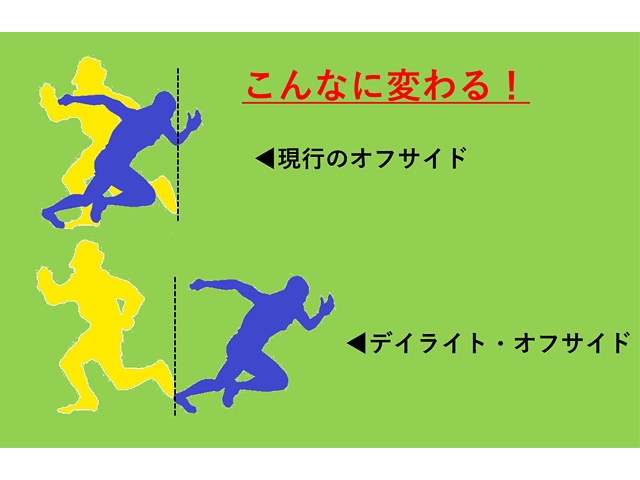
Under the current offside law, an attacking player is considered to be in an offside position if any part of their body, other than the hands and arms, is closer to the goal line than both the ball and the second-last defender. If that player then plays the ball or otherwise becomes involved in active play, an offside offence is committed.
Under the daylight offside rule, however, an attacking player is penalised only if their body is completely beyond the second-last defender. If any part of the attacker remains level with the defender, play continues. The idea was proposed by Arsene WENGER, the former Arsenal manager and now FIFA’s Chief of Global Football Development and is therefore also known as the “Wenger Rule.”
With the approval of the International Football Association Board (IFAB), the body responsible for determining the Laws of the Game, the new rule is being trialled in the CPL this season. Its first use came during Matchweek 3 on 18 April. Diaz became the first player to score under the new rule when he broke the deadlock in the 20th minute of Pacific FC's away match against Halifax Wanderers.
Canada’s three biggest clubs—Vancouver Whitecaps, Toronto FC and CF Montreal—currently compete in Major League Soccer (MLS) in the United States. Although all three also compete in the Canadian Championship and have won 14 of its 18 editions, the rest of Canadian football long lacked a national professional league of its own. The CPL was therefore launched in 2019 as a nationwide league for clubs outside MLS. It is the world's youngest professional football league.
The CPL has expanded to eight clubs this season. In the 2025 season, when the league featured seven clubs, average attendance was 3,988 spectators per match—roughly comparable to Japan's J3 League (3,766). In every sense, it remains a league with much room to grow. Yet this young league has chosen to experiment with daylight offside, a change some believe could fundamentally reshape football itself.
When Pacific midfielder Baldisimo took his shot, eventual scorer Diaz was positioned mostly beyond the defensive line. The goalkeeper's save then fell directly to him. Because a deliberate save does not reset offside, the goal would have been disallowed under the current law. However, one crucial detail changed everything. Halifax midfielder Lorenzo CALLEGARI, who formed the last line of defence, was still marginally level with Diaz. VAR confirmed that fact, and Pacific's opening goal was awarded.
The word “daylight” literally means sunlight, and by extension has come to signify something that is clear and unmistakable. Under this new rule, an attacker is offside only when there is clear daylight between the attacker and defender.
The offside law was transformed in 1925 when it changed from requiring three defenders to two, a revision that revolutionised football tactics. The daylight offside rule could have an impact comparable to—or perhaps even greater than—that historic change. There is already speculation that it could be adopted permanently as early as 2027. How would football change if this new rule became part of the Laws of the Game? It is an intriguing question for all of us to consider.
Written by OSUMI Yoshiyuki (Football Journalist)
*This article was originally posted on the Japan Football Association Newsletter, “JFAnews,” May 2026 edition.
Japan Football Association Newsletter “JFAnews”
The Japan Football Association Newsletter “JFAnews” contains all the information on the Japan National Team, events hosted by JFA, tournament results, and team information throughout the nation. The official monthly magazine is a must read for coaches, referees, and all members of the football family.
For information on the newest edition (Japanese website)
Related News
-
Respect and fair play
2026/05/25
Queens of Fair Play – Always Have Respect Vol.156

-
Respect and fair play
2026/04/24
Celebrating the Victors from the Heart – Always Have Respect Vol.155
-
Respect and fair play
2026/03/25
Sharing Our Mistakes for the Next Generation – Always Have Respect Vol.154
-
Respect and fair play
2026/02/25
In the Heat of a Cup Final – Always Have Respect Vol.153
-
Respect and fair play
2026/01/22
Showing Consideration Amid a Serious Accident – Always Have Respect Vol.152
Latest News
-
National Teams
2026/07/01
【Match Report】SAMURAI BLUE Take Early Lead Against Brazil but Fall 2-1, Once Again Fail to Progress Past the First Knockout Round at the Fifth Attempt
-
National Teams
2026/06/27
【Match Report】SAMURAI BLUE Secure Second-Place Finish and Round of 32 Spot with Draw Against Sweden
-
National Teams
2026/06/24
U-17 Japan Women's National Team squad & schedule - International Friendly Match vs U-17 USA Women's National Team (6/30-7/7@JFA YUME Field)
-
Respect and fair play
2026/06/23
Offside in Broad Daylight? – Always Have Respect Vol.157
-
National Teams
2026/06/22
【Match Report】SAMURAI BLUE Score Four Against Tunisia to Record Japan's Highest-Ever Goal Tally in a World Cup Match and Move Closer to the Knockout Stage