

Principles, Purpose and History
Principles
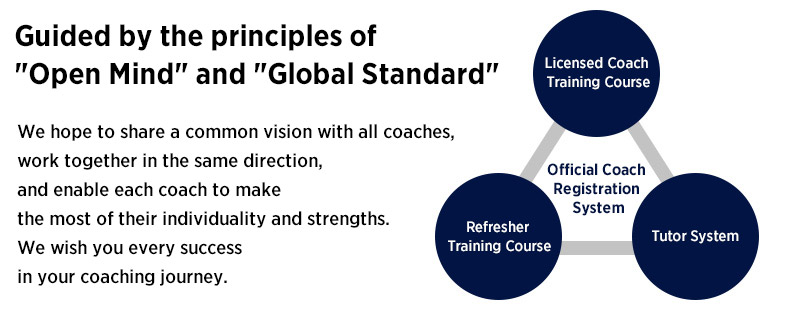
Purpose
The JFA Coach Licence System aims to help coaches acquire the knowledge, skills, and competencies required to continue developing as coaches, provide players and children with a safe and secure environment, and enable more players and children to enjoy football.
As stated in the JFA Declaration 2005, our goal is for Japan to win the FIFA World Cup™ by 2050. To achieve this, we must continue improving, keep pace with the rapidly developing football nations across Asia, and break through the quarter-final barrier on the world stage. We must continue learning from developments in world football while pursuing and establishing “Japan's Way”—a distinctive style of football that builds on Japan's own strengths rather than simply copying the world's leading football nations. To achieve this, coaches must share a clear vision, work toward common goals, and combine their efforts. Improving the quality of coaching is therefore essential. Not only must coaches working with elite players continue to develop, but grassroots coaches must also deepen their understanding of football and their engagement with players. While no coach can develop every player into a Japan international, every coach can help players develop a lifelong love of football. Only when football is enjoyed and played throughout Japan can this dream become a reality.
Unfortunately, corporal punishment, physical violence, verbal abuse, and harassment continue to occur in sport, depriving children of both the enjoyment of sport and opportunities for healthy physical and emotional development. We believe that every team should have coaches equipped with the fundamental knowledge and coaching skills needed to ensure that children can enjoy football in a safe, supportive, and secure environment.
History
| Year | Description |
|---|---|
| 1957 | JFA held its first nationwide coach training course. |
| 1958 | *Following revisions to the Course of Study, football was approved for inclusion in the physical education curriculum at elementary, junior high and senior high schools. |
| 1959 | A nationwide coach training course for instructors at teacher-training universities was launched. |
| 1960 | German coach Dettmar Cramer visited Japan for the first time and coached Japan national team players. |
| 1962 | *Football was introduced into the regular physical education curriculum at elementary schools. |
| 1963 | *Football was introduced into the regular physical education curriculum at junior high schools. |
| 1964 | *Football was introduced into the regular physical education curriculum at senior high schools. |
| 1969 | The first FIFA Coaching School in Japan was held at Kemigawa Ground in Chiba, with Dettmar Cramer serving as the lead instructor. |
| 1970 | The inaugural JFA Coaching School and the first JFA Football Leader Certification Course were held. JFA launched two coach licensing pathways: JFA-certified coaches, who provided specialist coaching, and certified leaders, who primarily coached children. In the first year, 27 coaches and 33 leaders were certified. |
| 1971 | The Coaches Association (CA), a voluntary organisation of JFA-certified coaches, was established within JFA. Its official journal, “SCA,” was also launched. |
| 1973 | The CA organised its first overseas coach education programme in England and other countries. |
| 1977 | Following the establishment of the Certified Sports Instructor System by the Japan Amateur Sports Association (now the Japan Sport Association), JFA introduced a progressive qualification structure comprising Certified Leader, Certified Coach and Certified Senior Coach. |
| 1984 | A Coach Education Department was established within the Technical Department. It was renamed the Coaching Department the following year. |
| 1988 | In line with reforms to the Certified Sports Instructor System introduced by the Japan Amateur Sports Association (now the Japan Sport Association), JFA established a three-tier structure comprising Certified C-Class Coach, Certified B-Class Coach and Certified A-Class Coach. |
| 1989 | The Coaching Committee was established. |
| 1991 | To address the shortage of coaches at prefectural level and strengthen coaching provision for boys and girls, JFA introduced its own Certified Associate Instructor qualification (now the JFA C Licence), and began offering training courses for the qualification. |
| 1992 | JFA independently established the Certified S-Class Coach qualification for coaches working with professional teams and players. |
| 1994 | JFA launched the Five-Year Certified Associate Instructor Development Plan, with the goal of training 9,000 Certified Associate Instructors. |
| 1996 | To enhance the Certified S-Class Coach Training Course, JFA and the J.League jointly established an endowed graduate-level programme at the University of Tsukuba. The programme continued until the 2000 academic year. |
| 1997 | To increase both the quality and number of football coaches, JFA introduced its own Certified Boys’ and Girls’ Football Instructor qualification (now the JFA D Licence). The curriculum for the Certified Associate Instructor Training Course was revised in accordance with the development policy for Category 4 (U-12 age group), set out in the JFA Guidelines for Player Development. This enabled the policy to be shared with coaches throughout Japan through JFA coach education courses. |
| 1998 | The Coaching Committee and the Player Development Committee were merged to form the Technical Committee. As part of JFA’s integrated approach to strengthening the game, a system was established through which lessons from international competitions and information relating to player development could be incorporated directly into coach education. JFA introduced an instructor system to develop JFA coach education instructors for the Certified B-Class and C-Class Coach Training Courses. The first JFA Football Conference was held. |
| 2000 | JFA began training instructors to deliver the Certified Boys’ and Girls’ Football Instructor Training Course and the Certified Associate Instructor Training Course. |
| 2001 | Certified Coach Refresher Training was divided into two categories: programmes organised by JFA (for Certified S-Class Coaches), and programmes organised by the prefectural football associations (for Certified A-, B- and C-Class Coaches, Regional Sports C-Class Instructors and Certified Associate Instructors). |
| 2002 | JFA introduced a training programme for instructors delivering its associate instructor courses, together with a refresher training programme to support their continued development. |
| 2004 | JFA established the JFA Certified Coach Registration System. Major reforms were introduced, including the restructuring and consolidation of JFA coaching qualifications, the launch of training programmes for Kids’ Leaders and certified goalkeeper coaches, and the introduction of a points-based system for refresher training. The Certified Goalkeeper B-Class and C-Class Coach Training Courses were launched. |
| 2005 | Certified A- and B-Class Coach Refresher Training was held across nine regions, with JFA National Training Centre coaches serving as instructors. Certified C-Class Coach Refresher Training was held in all 47 prefectures, led by the chief instructor of each prefectural football association. The Certified Goalkeeper A-Class Coach Training Course was launched. Certified C- and D-Class Coach Training Courses began to be offered by universities, vocational schools and other educational institutions. |
| 2006 | Voluntary registration for JFA-certified Kids’ Leaders was introduced. JFA launched the JFA International Coaching Course for coaches from across Asia. |
| 2007 | The Certified A-Class Coach U-12 Training Course was launched. E-learning was introduced for the common curriculum of the Certified B-Class Coach Training Course. Arrangements were established for the JFA Certified S-, A- and B-Class coaching qualifications to be recognised as equivalent to the corresponding AFC licences. |
| 2008 | The Certified Futsal C-Class Coach Training Course was introduced as an additional specialist qualification. |
| 2011 | The Certified Futsal B-Class Coach Training Course was introduced as an additional specialist qualification. |
| 2013 | JFA issued a declaration calling for the eradication of violence in football coaching environments. |
| 2015 | The Certified A-Class Coach U-15 Training Course was launched. The Certified Futsal B-Class and C-Class Coach qualifications were incorporated into the main JFA coaching licence system. |
| 2016 | An FA course was introduced as part of the Certified B-Class Coach Training Course. |
| 2017 | The Certified Futsal A-Class Coach Training Course was launched. |
| 2018 | JFA attained Pro Level membership of the AFC Coaching Convention, becoming the first AFC member association to do so. |
| 2019 | Arrangements were established for the JFA Certified Futsal B-Class and C-Class coaching qualifications to be recognised as equivalent to the corresponding AFC licences. |
| 2020 | The Associate Pro (A-Pro) Licence Coach Training Course for women, was introduced for a limited period. The goalkeeper coaching qualifications were renamed as follows: Goalkeeper Level 1, formerly Goalkeeper C-Class; Goalkeeper Level 2, formerly Goalkeeper B-Class; and Goalkeeper Level 3, formerly Goalkeeper A-Class. A new Goalkeeper A Licence Coach Training Course was launched. |
| 2021 | The Certified Physical Fitness C-Class Coach Training Course was launched. An FA course was introduced as part of the Certified Goalkeeper Level 1 Coach Training Course. |
| 2022 | The Certified Physical Fitness B-Class Coach Training Course was launched. The Certified Futsal Goalkeeper C-Class Coach Training Course was launched. To better reflect the actual delivery of coach education and refresher programmes, the designation “instructor” was replaced with “tutor.” |
| 2023 | The Certified Youth B Coach Training Course was launched. The minimum eligible age for the Certified C-Class Coach Training Course, Certified D-Class Coach Training Course and Certified Futsal C-Class Coach Training Course was lowered from 18 to 15. |
| 2024 | The names of JFA coaching licences were revised in accordance with the AFC Coaching Convention. |